

MONKEYPATCHED
AI AGENTS
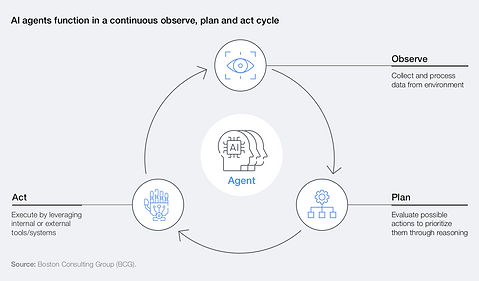
AI agents amplify the impact of large language models(LLMs) by giving them access to tools and enhancing their ability to observe, plan and execute actions. Traditional AI algorithms, such as machine learning, are task-specific and require human input for defining tasks, providing data and interpreting results. In contrast, AI agents, once trained,can operate and achieve specific objectives autonomously,continuously observing their environment, planning actions and harnessing tools to execute complex tasks. AI agents function in a continuous observe, plan and act cycle, which makes them particularly valuable for operations. Each step is enabled by interfaces or modules
Observe: Agents collect and process data from the environment, including multimodal data, user input or data from other agents. For example, an agent can perceive deviations in production quality and underlying parameters in real time
Agent-centric interfaces: Agents require protocols,application programming interfaces (APIs) and specifically designed interfaces to input multimodal data or perceive real-time data from multiple sources.Memory module: Agents have short- and long-term memory, which allows them to remember general knowledge, past actions and decision-making.
Plan: Agents and their underlying LLMs evaluate possible actions to prioritise them through logical reasoning, in accordance with their objectives. In the example above,the agent reviews possible actions to improve quality and decides to change production parameters.–The roles can be predefined, or agents can be flexible and dynamically adapt to new roles.Profile module: Agents have defined attributes,identities, roles or behavioural patterns.Reasoning module: Agents have limited reasoning capabilities. The underlying LLM is capable of decomposing the agent’s prompts and returning an actionable plan. It extracts key insights and makes logical connections by replicating reasoning steps observed in training data. This enables agents to decide on the required next steps by breaking down complex tasks into small actions to achieve their objectives. Recent studies have shown that current LLMs are not yet capable of formal reasoning. Real-world solutions thus require other types of AI and solvers and cannot solely rely on existing LLMs.
Act: Agents execute actions by harnessing internal or external tools and systems. For example, an agent accesses the machine controller and changes the defined machine parameters.–Action module: Agents decide which tools to use,using access mechanisms such as APIs, system integrations or other agents as needed.Functioning in this cycle, agents continuously learn from self-reflection or external feedback. Through goal-oriented learning approaches, such as reinforcement learning, agents continuously adapt and refine their strategies over time.This makes them particularly valuable in complex, dynamic environments where conditions and objectives are constantly shifting. Such environments can be found widely across industrial operations. As part of multi-agent systems, in which specialized agents work together by dividing complex problems among themselves, they can automate entire processes end-to-end.
MONKEYMIND
Expert systems can be designed to handle various manufacturing constraints by utilizing a knowledge base and an LLM Agent .Data-aware systems play a crucial role in enhancing the perception of physical objects in shop-floor environments. These systems integrate advanced technologies, including precise resource tracking, positioning, and optimized data transmission through wireless sensor networks.
By leveraging data-aware systems, manufacturers can enable real-time monitoring within workshops. These systems support manufacturing execution in key areas such as production order allocation, material flow optimization, and equipment collaboration.
In unexpected conditions, agents can adapt the corresponding production planning systems by applying their built-in planing capabilities to analyze the situation, providing informed decisions to maintain efficiency and minimize disruptions in the manufacturing process. correspondingly changes required in demand planning and material procurement processes can also be updated also automatic task assignments for workers and robots can be adjusted to meet the required production throughput these processes ensure that production schedules align with inventory levels and customer demand, reducing waste and optimizing resource utilization.
Our architecture transforms robots and machines from pre-programmed machines into adaptive, collaborative, and continuously improving systems. It blends Generative AI, multi-agent orchestration, and embodied AI to bridge the gap between digital intelligence and physical execution.
1. Data & Sensing Layer
machines and connected systems continuously generate multi-modal data:
-
IoT data
-
Telemetry from motors, actuators, and sensors
-
Computer vision streams from cameras and LiDAR
-
Process data from SCADA
-
PLC data and commands to control system
-
ERP
-
MES,
-
WMS
Organisations also have a lot of unstructured data in form of documents these include
-
Research papers,
-
White papers
-
Manuals
-
Request for quotations
-
Scheduling logs
-
Purchase orders
-
Invoices
-
Standard operating procedures
-
Machine logs
-
Simulation data
-
Computer Aided drawings
-
Images
-
Audio Data
-
Voice data
This data forms the raw context for intelligent decision-making.
2. Knowledge & Memory Layer
We unify all incoming information into a Knowledge Graph linking
-
Machine capabilities
-
Task dependencies
-
Maintenance history
-
Supplier and inventory data
-
Product Data
-
Product BOM
-
Demand planning modules
3. Retrieval augmented generation and search layer
Visual and sensor data are stored in a Vector Database for rapid similarity search — enabling robots and machines to recognize patterns they’ve seen before.
4. GenAI Reasoning Layer
GenAI models act as the brain for decision-making:
-
Understand natural language instructions
-
Generate optimized motion plans from CAD data
-
Predict production bottlenecks or failures
-
Create dynamic workflows without manual reprogramming
This layer ensures the system can adapt to new products, environments, and constraints instantly.
4. Multi-Agent Orchestration Layer
Specialized autonomous agents handle different aspects of operations:
-
Assembly Agent – Configures robots for new product lines
-
Logistics Agent – Coordinates AMRs/AGVs for material movement
-
Inspection Agent – Detects and classifies defects in real time
-
Maintenance Agent – Predicts and executes preventive repairs
-
Collaboration Agent – Interprets and executes human instructions safely
Agents communicate via a message bus (e.g., NATS, Kafka), sharing real-time insights to synchronize production, quality control, and logistics.
5. Embodied AI Execution Layer This is where intelligence meets action:Perception – Vision, LiDAR, and tactile sensors interpret the environmentPlanning – Path and motion planning adapt to changing conditionsControl – Low-latency actuation for precise physical movementsLearning – Robots improve through reinforcement learning and human demonstration feedbackThis layer gives robots the dexterity, adaptability, and safety to operate a longside humans or in unpredictable environments.
6. Predictive models Layer :
Traditional maintenance relies on fixed schedules or reactive repairs — both costly and inefficient. Predictive Maintenance (PdM) uses continuous data analysis to anticipate failures before they occur, minimizing downtime and repair costs. Our system combines gen AI with predictive models to generate corrective steps
FEATURES
Multimodal AI
Multimodal AI works with:
-
Visual Data – Images, video, 3D scans, thermal imagery
-
Audio Data – Speech, machine sounds, environmental noise patterns
-
Text & Language – Manuals, reports, work orders, chat instructions
-
Sensor Data – Vibration, temperature, pressure, force feedback
-
Structured Data – ERP records, IoT telemetry, production KPIs
Explainable AI
ensures that every AI-driven recommendation or action comes with clear reasoning that humans can understand, verify, and trust.
With XAI:
-
Engineers understand why a predictive maintenance alert was triggered
-
Managers see which factors influenced production adjustments
-
Safety officers get clear, auditable reasoning for compliance reports
Responsible AI
AI in industrial automation can unlock massive efficiency gains — but only if it’s built responsibly.Responsible AI ensures that every decision made by intelligent systems is ethical, transparent, safe, and aligned with human and organizational values.
-
Fairness & Bias Mitigation – AI models are trained and tested to avoid decisions that unfairly disadvantage people, suppliers, or processes.
-
Transparency – Users can see and understand how decisions are made, supported by Explainable AI tools.
Safety and Data Security
As robotics, AI agents, and connected systems integrate deeper into industrial operations, cybersecurity becomes mission-critical. A single breach could halt production, compromise sensitive data, or cause unsafe machine behavior. Our architecture embeds security at every layer, ensuring AI-driven automation remains resilient, private, and protected.
Human in loop
Even the most advanced AI and robotics systems operate best when paired with human expertise and oversight.Human-in-the-Loop (HITL) ensures that people remain decision-makers, guiding, validating, and improving AI-driven automation.
Why HITL Matters
Safety – Humans can intervene in critical situations to prevent accidents.Trust – Operators can review and approve AI recommendations before execution
Continuous Improvement – Human feedback helps AI models learn faster and avoid repeating mistakes.Compliance – Regulatory standards often require human validation of automated decisions.
Graph RAG
Most RAG systems rely only on vector databases, which find relevant chunks of text based on similarity search. Graph RAG takes it further by retrieving knowledge from a structured knowledge graph — linking entities, relationships, and context — so AI agents can reason more like humans.
Why Graph RAG is Powerful
-
Relationship-Aware
-
Multi-Hop Reasoning
-
Hybrid search
-
Fewer hallucinations
-
More relevant answers
PLATFORM
_edited.jpg)